Automotive


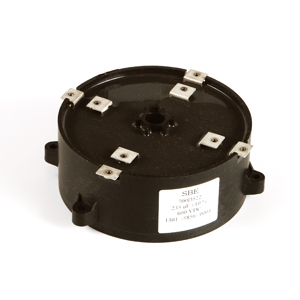
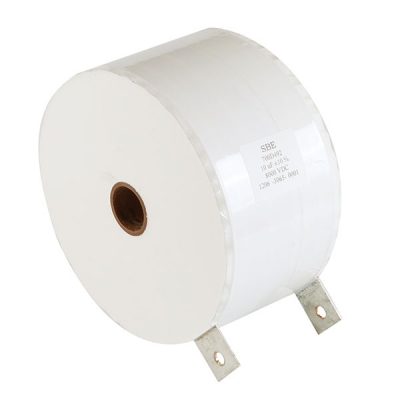
Power Ring Film Capacitors™ bring the following advantages and allow our engineering team to develop with you leading-edge solutions for your inverters:

    ev_car_200

  • Ability to handle higher ripple currents with less capacitance, weight, and volume
  • Use of 105°C ICE coolant for power electronics cooling
  • Longer inverter MTBF due to uniform current density, inductance, and dissipation
  • Elimination of IGBT overshoot and snubber capacitors
  • Most effective isolation of DC storage or supply from AC switching artifacts
  • Lowest industry ESL at <4nH for packaged device and <2nH in integratable form
  • Smaller inverter packaging in packaged or integrable form   
  • Overall system cost savings

The main application of the Power Ring Film Capacitor in HEV, PHEV, Fuel Cell, and EV systems is for the DC Link Capacitor used in inverters. Typical voltages range from 250V – 1500Vdc and ripple currents range from 40 – 5400 Arms at 10 – 100khz switching frequencies. In earlier applications, Aluminum Electrolytics were used extensively for DC Link capacitors, however, as voltages and ripple currents rise, these may not be the best choice any longer for reliable, size efficient use.

The Power Ring Film Capacitor allows for a much reduced capacitor volume and cost for a design’s given ripple current requirement. SBE has the simulation and design tools to help you safely predict the right DC Link Capacitor size for your requirement with confidence.

Use of 105°C ICE coolant for power electronics cooling
The Power Ring Film Capacitor has much lower losses than a conventional array (see graph) and therefore has much less cooling requirement and can provide for significantly greater ripple current filtering in less space, using less weight, and costing less money.

SBE is finalizing Life Test data as part of a U.S. Department of Energy study which will provide the designer with reliability data to safely choose a high coolant temperature design. Specific data will be available 3Q2010. 

graph temperature rise power ring vs conventional capacitor

Changing Design Criteria
Until now, it has been commonly believed that in order to achieve significant ripple current increases in a DC Link Capacitor bank, a designer needed to greatly increase overall capacitance. This often greatly increased size, weight, and cost.

With SBE’s Power Ring Film Capacitor, for the first time, the capacitor has been “designed for increased current” rather than the typical approach of adding more and more capacitors until the current rating is achieved. The system results can be remarkable.

capacitance ripple current graph capacitor

Design Optimization using the SBE Power Ring Film Capacitor
It is important now to discuss the implications of lower Temperature Rise, lower ESL, and lower ESR on the design and performance of the inverter. Before beginning any design project with a Ring Capacitor, it is critical to identify the critical constraints on the project to ensure key goals are achieved. Inverter projects can be broken down into three general categories as follows:

  1. Drop in Replacement – the design specification is complete, however, there is an opportunity to replace the traditional capacitors with Ring Capacitors by leveraging the same space;
  2. Modification to an Existing Design – the volumetric size and dimensions of the design specification are complete, however, there is an opportunity to change the internal layout and connections of the active and passive components; See more discussion on an actual design.
  3. Complete New Design – the design specification has not been defined and there is an opportunity to explore new options without the constraints of an existing design.

Application of the Ring Capacitor technology into each of these three categories will yield improved performance, however, the more flexibility in the design parameters, the more opportunity exists for a breakthrough in W/cm3, cost, reliability, and size. The ability to achieve high density design goals for inverters is directly impacted by the constraints on the development cycle.

As discussed, the unique temperature rise characteristics of the Power Ring Film Capacitor enable the development of a low inductance co-planar bus structure. The capacitors allow for short, equal length connections while delivering high current handling capability. In addition, ring capacitor connection systems allow for direct connection of the capacitor to the heat sinks thus achieving lower temperatures. Careful attention must be put on the losses transferred to the capacitor terminals as the capacitors are mounted closer to the IGBT Modules. Simulation tools are a necessary tool to understand the unintended consequences of making these changes.

The net result is a tighter, more compact inverter design with significantly reduced voltage overshoot and switching losses.

Contact our application engineering team to discuss your requirements.

Additional Readings: 

  1. Our technical team has presented numerous technical papers/presentations on the subject of using the Power Ring Film Capacitor in the DC Link Application including optimum ways of connecting the capacitor to the switch bus. Two papers of particular interest are “Low Inductance – Low Temp Rise DC Bus Capacitor Properties Enabling the Optimization of High Power Inverters”, presented at PCIM Europe 2010 and “A fully integrated 3 phase IGBT switching assembly with a very low loss DC Link Capacitor”, presented at VPPC 2009.
  2. DoE Research of DC Link Film Capacitors using 105°C Coolant
    SBE Inc. has been the recipient of a Phase I and Phase II grant from the Department of Energy (DoE). See here for details on initial results and progress.
  3. Examples of actual electric transportation applications. Click here for detailed specifications.
    • Powertrain Inverter DC Link
    • Electrification Inverter for Truck Applications
    • Military Hybridization
    • Storage Container Electrification